
 A prepaid label does not replace correct waste classification, carrier acceptance, compliant packaging, or documentation.
Published by PureWay Compliance. Research and source review current as of September 18, 2026.
The sharps-disposal market has changed dramatically. Healthcare facilities, employers, pharmacies, home-health programs, community organizations, and individual patients can now purchase a container online, fill it with used sharps, seal a return box, attach a prepaid label, and send it away for destruction.
That convenience is valuable, but it can also create a dangerous assumption: if a vendor sold the system and supplied the shipping label, the shipment must be compliant.
That assumption deserves scrutiny.
A growing number of look-alike or "copycat-style" return systems are marketed with the same basic value proposition as established regulated medical waste mail back programs: collect the sharps, close the container, ship it back. The real compliance question isn't how convenient the system looks. It's what material is actually being transported, how that material is classified, whether the carrier accepts it, whether the packaging is authorized for that use, and what regulatory framework supports the shipment. For sharps generators, those distinctions matter.
Key Takeaways
- A prepaid shipping label does not automatically make a sharps mail back system compliant.
- Waste classification matters. Commercially generated sharps may qualify as UN3291 Regulated Medical Waste and must be handled accordingly.
- Carrier acceptance and regulatory classification are separate issues. Organizations should verify that the carrier expressly accepts the waste being shipped.
- Packaging should be properly authorized and tested for factors such as leakage, drops, puncture resistance, weight and containment integrity.
- Documentation is essential. Sharps generators should be able to verify how waste is classified, transported, tracked and ultimately treated or destroyed.
- That combination should prompt questions rather than assumptions.
- What classification is actually being applied to the returned material?
- What standard determines that the contents qualify for the classification the label describes?
- Who is responsible for confirming that condition before the package is accepted for transport?
- How does the program reconcile a general-carrier return process with that carrier's own published restrictions on medical, clinical, or regulated waste?
Mail Back Sharps Disposal Starts With the Waste, Not the Shipping Label
Under 49 CFR § 173.134, regulated medical waste includes waste or reusable material derived from medical treatment, diagnosis, immunization, or biomedical research. The regulation separately defines "sharps" as objects contaminated or that may become contaminated with a pathogen and that can cut or penetrate skin or packaging. Needles and syringes are specifically included.
The same regulation defines a "used health care product" differently. Critically, a used health care product is something that does not meet the definition of regulated medical waste, a patient specimen, or a biological product. That distinction is not academic.
PHMSA addressed almost this exact issue in Interpretation 12-0028. When asked whether sharps used by medical facilities and intended for disposal or recycling could be classified as "Used Healthcare Products" and transported by a commercial carrier such as UPS, their answer was no.
PHMSA explained that qualifying products (including sharps used by medical facilities and suspected of Category B contamination) when transported for disposal or recycling, meet the definition of UN3291 Regulated Medical Waste. The interpretation also emphasized that it is the shipper's responsibility under § 173.22 to properly classify hazardous material before offering it for transportation.
One limitation is worth flagging. PHMSA 12-0028 addressed sharps generated by clinics, dental offices, veterinary practices, long-term-care facilities, occupational medicine providers, and other commercial or governmental operations. It should not automatically be extended to every needle generated by an individual in a private residence. Federal regulations contain an exception for household-generated medical waste when transported in accordance with applicable state, local, or tribal requirements. But that exception answers only part of the question.
DOT Classification and Carrier Acceptance Are Two Different Things
Even when a shipment qualifies for a regulatory exception, the carrier still has its own acceptance rules. UPS's current U.S. guidance is unusually direct: "UPS does not accept Medical, Clinical or Regulated Waste for transportation." UPS further states that this includes waste that might be reclassified under another proper shipping name.
That creates a simple compliance question every purchaser of a UPS-based sharps-return program should ask: if my package contains used medical sharps, what written authority permits UPS to accept this particular material?
There may be circumstances involving a regulatory exception, specially prepared material, a specific contractual arrangement, or facts that materially change the classification. Yet, those circumstances need to be documented, not assumed. A prepaid shipping label, by itself, is not evidence that the material has been correctly classified or that the carrier has expressly accepted the commodity.
This matters most for commercial generators. PHMSA has already stated that facility-generated sharps being transported for disposal cannot simply be transformed into "used health care products" by changing their description. Under § 173.22, responsibility for classification and authorized packaging rests with the person offering the hazardous material for transportation or who is often referred to as the generator of waste.
Why USPS UN3291 Mail Back Is Different
USPS has built a specific regulatory structure for mailing sharps waste and regulated medical waste. Publication 52 § 346.322 and Packaging Instruction 6D identify Regulated Medical Waste, UN3291 and Sharps Medical Waste, UN3291, and require vendors supplying complete mail back systems to obtain Postal Service authorization before those systems may be mailed. Current USPS rules require the container design to undergo independent package testing before authorization.
This is far more than putting postage on a cardboard box. USPS requires authorized packaging systems, appropriate primary receptacles, secondary containment, absorbent material, biohazard markings, the applicable proper shipping name and UN3291 identification, USPS Returns Service through USPS Ground Advantage, vendor identification and authorization information, orientation markings, a shipping paper, emergency-response information, and package testing that evaluates leakage, vibration, drops, puncture resistance, temperature performance, and containment integrity. USPS also requires the vendor seeking authorization to demonstrate financial responsibility, including a $50,000 surety bond or letter of credit.
That is the fundamental difference between a carrier-authorized regulated-medical-waste program and a box that merely arrives with a prepaid return label.
Large Systems Deserve More Scrutiny, Not Less
A large-capacity container is not inherently unlawful simply because of its size. Size alone is the wrong compliance test.
USPS itself permits a category called Medical Professional Packages that can use a primary receptacle larger than five gallons for properly contained pre-primary sharps receptacles and other regulated medical waste. Those packages are subject to specific requirements, meaning the inner sharps receptacles must be rigid, securely closed, puncture- and leak-resistant, and meet applicable OSHA standards. The completed USPS Medical Professional Package may not exceed 35 pounds, and the package must be tested at its authorized maximum weight.
That illustrates the real issue: capacity does not replace engineering controls. DOT's general regulated-medical-waste packaging rules also impose specific performance requirements on sharps packagings. Under 49 CFR § 173.197, non-bulk RMW packagings generally must meet applicable UN Packing Group II performance requirements, and sharps packagings must resist puncture and be securely closed against leaks and punctures.
When a vendor markets an 18-, 28-, or other large-capacity return-shipping system, the right question isn't "how many syringes will it hold?" It's “What regulatory pathway authorizes the package at the weight, configuration, carrier, and contents being advertised?”
A Pattern in the Sharps Disposal Mail Back Market Worth Watching
A number of mail back sharps disposal systems currently sold and marketed to healthcare facilities, businesses, and consumers rely on general parcel carriers rather than a carrier-authorized regulated-medical-waste program. Some of these products are marketed with language suggesting broad regulatory approval, while the fine print in their own return instructions places real limits on what can be shipped. For example, they may require that sharps be free of visible contamination, cap return weight, or instruct the customer to disinfect any exposed material before shipment.
None of this is to suggest that every product on the market today is out of compliance. It's to say that a customer shouldn't rely on a general website statement or marketing claim alone. The only way to know what you're actually purchasing is to verify the exact SKU, the actual carrier label, the applicable authorization, the permitted contents, and the shipping instructions. This must be provided in writing, from the vendor.
This Is a Worker Safety Issue, Not Just a Shipping Technicality
EPA warns that improperly managed discarded needles can expose waste workers to needlestick injuries and potential infection, particularly when containers break open or sharps enter ordinary waste or recycling streams. Janitors and housekeepers can also be injured, and used needles can transmit serious diseases.
OSHA's Bloodborne Pathogens Standard requires contaminated sharps to be placed in containers that are closable, puncture resistant, leakproof on the sides and bottom, and appropriately labeled or color-coded. When those containers are moved, they must be closed before removal to prevent spilling or protrusion during handling, storage, transport, or shipping.
Those requirements explain why classification, package integrity, carrier handling, and weight limits matter. A needle doesn't become less capable of puncturing a worker simply because a shipping label has been printed.
7 Questions Every Sharps Generator Should Ask
Before purchasing or renewing any mail back or return-shipping program, require the vendor to answer these questions in writing:
- What is the exact regulatory classification of the waste after use?
- Which carrier is transporting it, and where does that carrier expressly authorize acceptance of that commodity?
- If "Used Health Care Product" is being used, why does the material not meet the definition of regulated medical waste?
- What packaging approval, authorization, testing, or specification applies to the exact container system being sold?
- What are the authorized maximum capacity and shipping weight, and were those limits part of the package testing?
- What shipping paper, manifest, tracking record, or certificate follows the waste from generator through treatment or destruction?
- What federal, state, and local requirements apply to the generator's location and waste stream?
A reputable vendor should be able to answer these without changing the subject.
PureWay's Approach to Mail Back Sharps Disposal: Make Compliance Verifiable
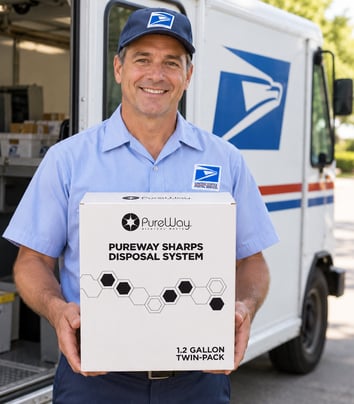
PureWay Compliance's public return instructions direct customers to close their sharps containers, secure them in the supplied return packaging, complete the tracking manifest, and return the system using the prepaid USPS label. PureWay's public materials also state that its sharps systems use USPS-approved packaging for UN3291 return transportation.
We intend to go one step further: making the regulatory documentation as transparent as possible. Where appropriate, we will identify the USPS authorization associated with each applicable system, explain how the tracking manifest works, identify maximum authorized weights, and clarify what a customer may and may not place into each system.
Compliance Should be Proven Before the First Needle Goes into the Container
There are many legitimate ways to manage sharps waste, and federal rules contain important distinctions between commercial regulated medical waste, household-generated medical waste, used health care products, private or contract carriage, and authorized mail back systems. State medical-waste requirements add another layer, since medical waste remains primarily regulated at the state level.
That complexity is exactly why a prepaid shipping label should never be the end of a compliance review. If your organization is using a sharps return program today, ask the provider to show you the classification, the packaging authority, the carrier's acceptance, the weight limitations, and the documentation trail. If those answers can't be produced clearly, find out why before the container is shipped. After it's rejected, damaged, questioned, or involved in an exposure, it’s too late.
PureWay Compliance reviews existing sharps programs for healthcare organizations, businesses, community programs, and other generators, and helps evaluate waste classification, packaging, transportation method, documentation, and applicable state requirements.
Proper sharps disposal isn't just about getting the waste out of your facility. It's about knowing that every step between generation and final treatment is defensible.
Download Our Sharps Disposal Compliance Whitepaper
Want to take a closer look at what makes a sharps disposal program compliant? Download our whitepaper, Protect Your Organization Through Compliant Sharps Disposal, to learn more about UN3291 regulated medical waste, packaging and transportation requirements, documentation, and your responsibilities as the waste generator.
Get the information you need to evaluate your current sharps disposal program and help protect your organization, staff, and patients.